|
Arborfield
|
|
Properties
Related sites:
Early postcards of the 'Bull' P.H. in Nicky Ford's Collection. Postcards of the 'Bull' P.H. in Martin Shearn's Collection The Parish Cottages in Arborfield, opposite the 'Bull' A Wedding Reception at the 'Bull Hotel' in 1917 - May Bushell and Trooper Duffield Arborfield Cross and the 'Bull', Winter 1927 (from Reading Local Studies Library website) When the 'Bull' became a temporary mortuary in 1931 The new Roundabout at the 'Bull' crossroads, opened in 2004 The Dissenters' Chapel, across the road from the 'Bull' until the 1850's |
We learn from an old deed that it was most certainly there in 1707, and there is also a mention in the Church Rate book of 1750 - “The Bull Alehouse rated at 4d. to Mr. May”.
In 1839 The Bull Inn was owned by Messrs. Willats
Blandy and the land alongside (known as The Orchard), now the copse, by
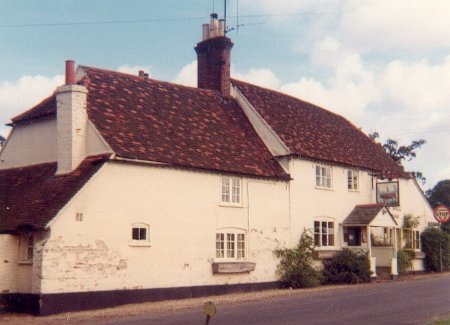
Messrs. J. & C. Simonds who also occupied it. “This inn (The Bull) is celebrated as being one of the places where Queen Victoria stopped to bait her horses, as she drove from Windsor to Stratfield Saye to pay a visit to the Duke of Wellington. Outside the Inn, and across the road, a triumphal arch was built to welcome her. Mrs. Stone told how Sir John Conroy of Arborfield House threatened instant dismissal to any of his employees if they went to the village to see Her Majesty go through. But old John Stone, he did not mind what Sir John said, but put on his best clothes and went. No notice was taken and he remained in the service of the Conroy’s and Hargreaves till he died well over 80.” There is an engraving from "The Illustrated London News," 25 January 1845 at Reading Local Studies Library showing this event. It is captioned "Changing the escort at Arborfield", on Queen Victoria's journey from Windsor to Stratfield Saye on 20th January 1845; the royal carriage is about to pass under an arch carrying the words "honesty" and "industry" and a crown emblem. To the right of the picture, people wave and raise their hats. Click here to see it. This land is named in the Newlands Estate Sale Documents of 1947 as being for sale by The Simonds Family. It was at the time let to Mr. Bushell, presumably “Jugger”, on a yearly tenancy of £2.10s.0d., although it is believed that his daughter, Lilian Hall ran the pub during the war, he was clearly still connected with it in 1947. He died in 1950. In September 1948 the copse alongside The Bull was sold by John Silvester Gardner to H & G Simonds Limited. “The Bull” public house has had various owners including H. G. Simonds Brewery, Courage, Barclay and Simonds, and later Courage Brewery. In 1999 a transfer of The Bull was made between Inntrepreneur Pub Company Limited and Unique Pub Properties Limited, and the pub was rebuilt in 2007 by Enterprise Inns plc. Here's a view of the Bull taken in 1972:
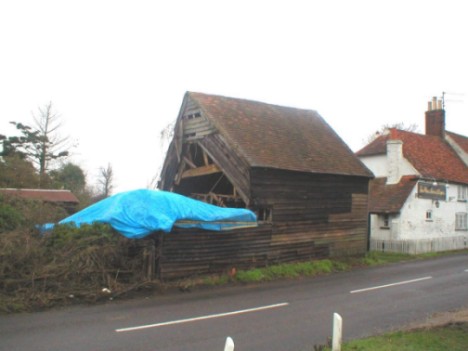
Sadly, the stable building alongside it on the Swallowfield Road had deteriorated badly by 2004, when it was partly blown down in a gale, as shown below. It was declared unsafe and was demolished by Wokingham District Council, with a promise from the owners that it would later be rebuilt. Happily, that did happen. As of 2007, the pub has been renovated and a restaurant has been added. Click here to see the rebuilding in progress.
Landlords The following were occupants of The Bull at Arborfield
according to Snares, Billings, Kellys, Dutton Allens or Harrods Post
Office Directories, 1842 - 1939: - by Anthony Walton
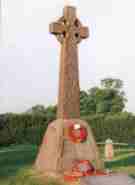
People have been brewing beer from 6,000 B.C., and more people have been drinking it. Caesar’s men found us brewing when they landed and remarked that Britons used vines only for arbours and preferred “to drink a high and mighty liquor different from that of any other nation, made of barley and water which leaves space enough for the performance of any great actions before the spirits are quite vanquished.” Well, I expect they were brewing away at Arborfield too, but not in the present building of the Bull, which is seventeenth century, and it is unlikely that they would have had such a pleasant and comfortable place in which to refresh their spirits. It is an attractive cream-washed building with some of its timber frame showing. With its red tiled roof it stands out pleasantly against the bright green background. The sign, a large and placid looking bull, hangs over the door to remind us of the days when people couldn’t read and such a pictorial indication of an inn was necessary. Near it is a larger blue sign announcing that it is a “Courage” pub. Most pubs today are owned by one or another of what is sometimes called “The Beerage”. It was never a famous hostelry, with a court yard that rang to the stamp of horses’ hoofs and the cries of ostlers and post-boys, only a little pub where the people of the village went to diminish their sorrows or tell of their joys. Possibly under the fresh new paint there are splashes of beer to celebrate Waterloo, the relief of Mafeking, the end of the Great War and the defeat of Hitler. As far as we know Queen Elizabeth never slept there but Queen Victoria did call in to change horses on her way to see the Duke of Wellington at Strathfield Saye. There is no mention of her having supped the ale, but that need not be taken as a reflection on The Bull or its beer as, unlike Queen Elizabeth I, whose “own beer was so strong as there was no man able to drink it” Queen Victoria was not renowned for her fondness for drink. King George III on the other hand is said to have refreshed himself at Arborfield when chasing a stag through the parish in 1780. It is also said that somewhere near there is a bridle path used by Highwaymen on their way to Southampton, so perhaps they too drank at The Bull. The Garth Hunt used to meet outside until a few years ago, but now the traffic has become too heavy and the place of hearty red-faced huntsmen has been taken by paler quieter motorists. In the last century the arrival of the railways, and Victorian snobbery, meant the decline of the public house, though I expect even then the village inn held its own as a local meeting place. In this century the return of road traffic has given country inns a new lease of life and an entirely different aspect. No longer the place where villagers get “drunk for a penny and dead drunk for twopence” they offer good food and company in pleasant surroundings. The Bull offers a real fire in winter, no plastic electric logs. There are no fancy fittings, it is not done up like “Ye Olde English Tavern” with plastic lanthorns and barmaids in print aprons, and there is no canned music. The proprietor’s wife however makes very good pates and pies and business men call in from distant places at lunchtime to eat them. Part of the large garden has been turned into a car park - publicans no longer have time to grow vegetables - but there is still some grass for tables and chairs for children to take their coca-cola and crisps and where those that prefer fresh air and a view of the little lambs in the field opposite can drink their beer. Sometimes on a summer evening the local troupe of Morris dancers trip and jingle in the car park in aid of charity, they are folk dance enthusiasts from Reading University. At the time of the Christmas draw the beer runs fast and free sausages and hot potatoes are served to one and all. The fire burns brightly and the atmosphere gets thick with smoke and joviality, so that it doesn’t really matter if once again you haven’t won a bottle of scotch or a Christmas hamper. At all times it is a pleasant place to visit after a morning’s gardening - to lean on the bar and view through the little old windows the village green with the war memorial where the old market cross used to stand, Victorian labourers’ cottages on their way up the social scale, and Georgian Gentlemen’s houses going down a bit now that their land has been sold, half-timbered cottages that have stood for 400 years and little modern “town” houses - a microcosm of the changing scene in South East England today. Then if you get tired of the view there is bar-billiards, darts or just talking. The public house has through the years reflected the changing scene. The Church, whose monks brought the first wine to England, gave us our first inns, for pilgrims to rest in and replenish themselves. Then in the 17th Century the thin ale of the middle ages gave place to strong beer, and England’s Inns became renowned as unique in the world. The inhabitants appreciated them too. England was reported to be full of “maultworms”, the term at the time for the modern “bar-fly”. A successful inn is one that grows into the times, patched and altered and added to over the centuries. It is a commercial undertaking so it always reflects the tastes of the day, and if it is to survive it must be the way people want it. The Bull has changed with the years - but not too much. There is no juke-box or one armed bandits, only a fire, good food, conversation, darts and bar billiards, just the way the people want it. In many ways it reflects the changes in our lives. The old “public” “saloon” and “lounge” is now one big bar where all meet and talk on equal terms, and there are no squires or country bumpkins. The front door, on a busy road, is bricked up and the entrance is at the back through the car park. This would have been frowned on in the last century as it was thought to encourage women and children and the criminal riff-raff to have a door at the back of a pub, so in many ways the changes it reflects are for the good. About tomorrow we can only guess. Perhaps there will be no village communities and all will be one vast urban area. Or maybe the high-rise flats and modern houses will fall and the old timber-frame buildings will remain. Could traffic leave the roads and take to the air so that, apart from an overhead buzz, the British countryside would be peaceful again and The Bull could once more open its front door? Personally I rather hope that everything will stay
just as it is, but that I fear is hardly possible and perhaps not even
desirable. - written by Anthony Walton May/June 1975 Click on the link for a series of 'Country Cameo' articles from 1965 to 1975, written by Anthony Walton under the name 'Rustic'
|
||
|
Any Feedback or comments on this website? Please e-mail the webmaster |