|
Arborfield
|
|
Properties
  Related sites:
Bearwood Estate Maps for Hurst (Liberty of Newland) and Arborfield 'Rough Music' - an article from 'Berkshire Old and New', No. 1, 1983 Royal Merchant Navy School and Bearwood College
Arthur Fraser Walter
Mrs. Walter, widow of John Walter III, who died in 1917
|
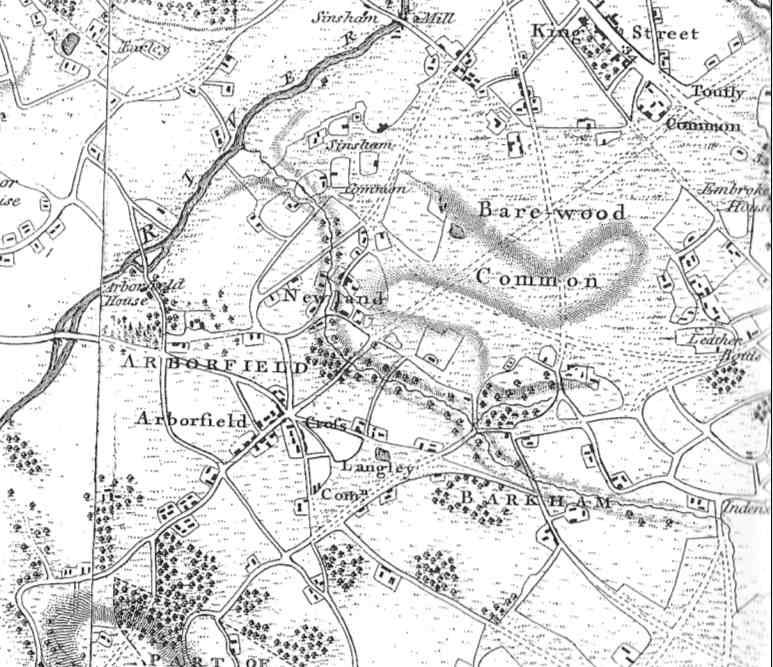
The Bearwood Walke In 1630, hunting at Bearwood was not as good as it might have been because stocks of game were low. So when the King (Charles I) sold off part of Windsor Forest, he decided to replenish the herd. Because he feared that they would wander off, he ordered Sir Francis Knolly and Richard Arrowsmith, joint keepers of the Bearwood Walke, to fence the animals in. One hundred and twenty acres of forest were enclosed and a lodge built for the keepers - (built in the 16th Century, some people believe that Langley Pond Farmhouse could have been one of the royal hunting lodges, due to the one complete roof as only a person with wealth could have afforded that type of structure) but this was resented by the people of Newland, Sindlesham and Winnersh. They had lost their rights of “free chase”, enjoyed when the Bishop of Salisbury held the land. One night, after dark, the people met together and “riotously pulled the fence down” They also petitioned to have the lodge removed. When the Civil War came (1642-9), the Royal landlords had more urgent things to worry about than hunting rights at Bearwood. During this war most of the deer were killed off and the lodge was demolished in 1655. The land at Bearwood remained part of the forest of Windsor and the people of the area reclaimed their rights. Thomas Pride's Map of 1790 (below) shows Bearwood as 'Bare Wood', whereas the Enclosure map of 1817 spells it 'Bere Wood', as you can see here when you visit the 'Berkshire Enclosure' web-site.
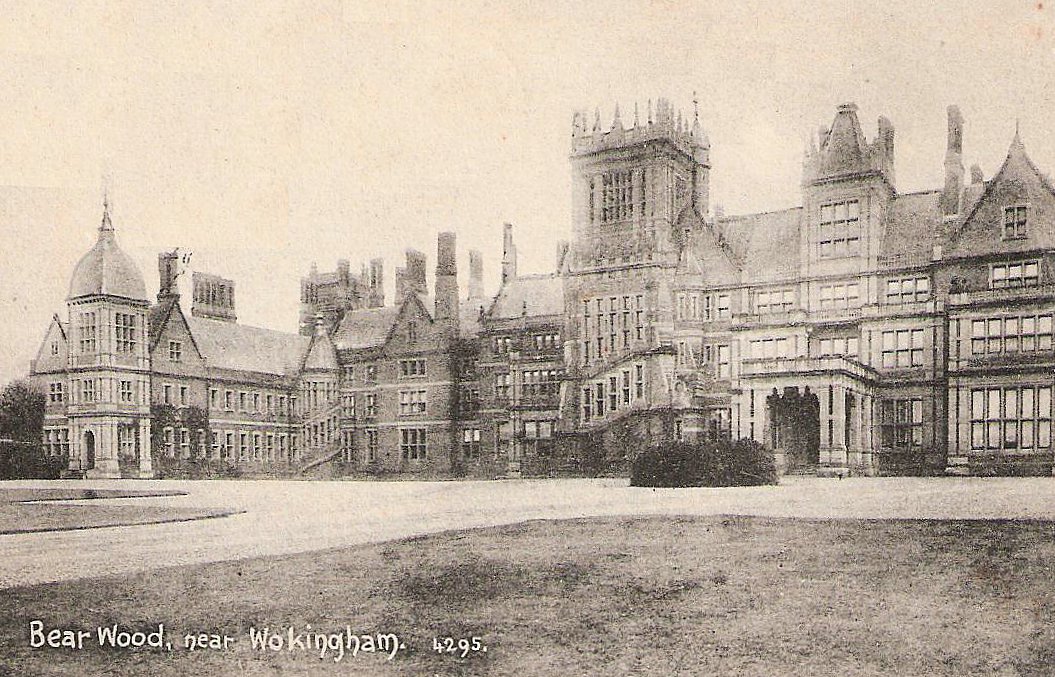
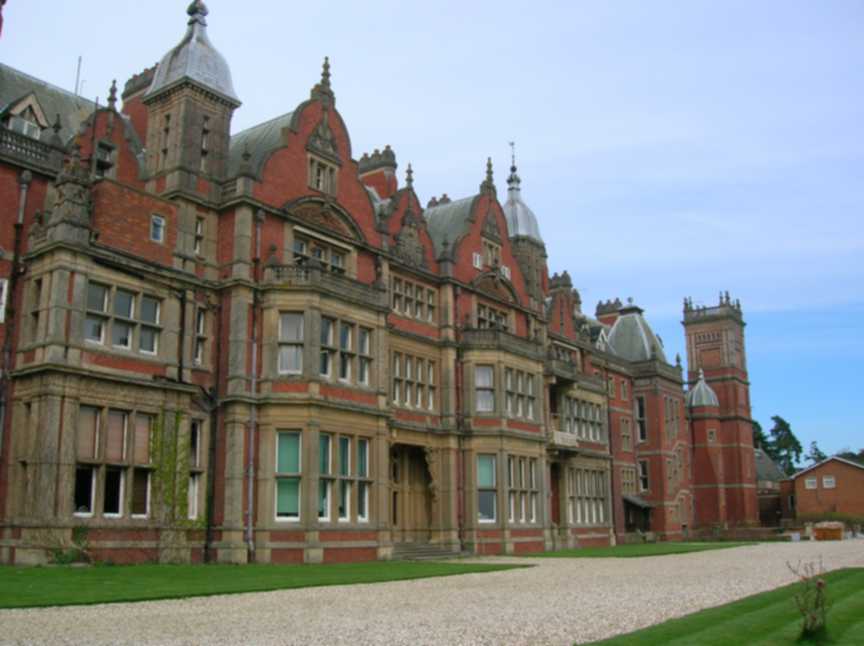
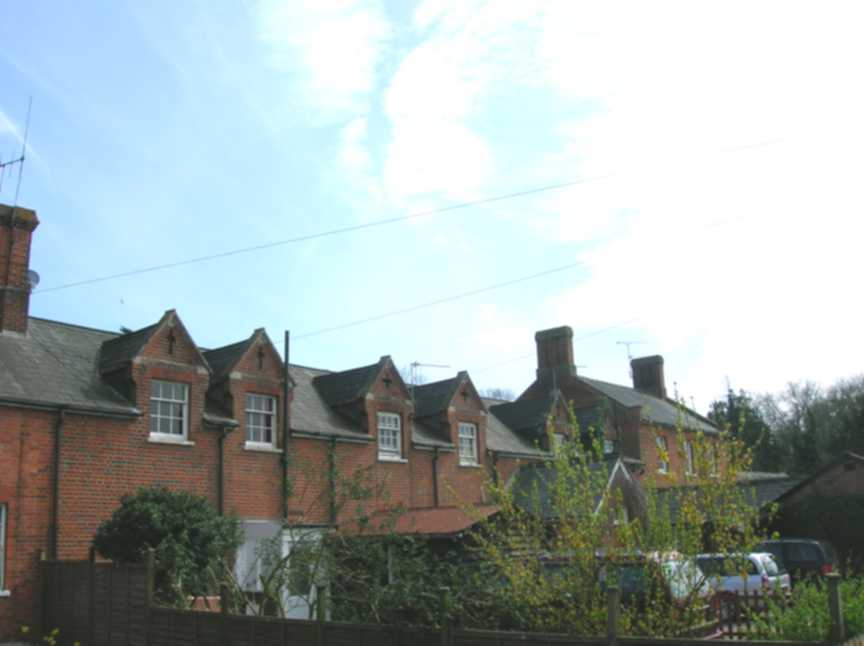
Sindlesham Model Village Although Sindlesham is outside the parish, Bearwood mansion itself is in the old Liberty of Newland. John Walter II, proprietor of 'The Times', created the estate. His son John Walter III built a model village at Sindlesham, arranged around a green. The Shell Book of English Villages says it "was laid out in the 1860's and 1870's in a Victorian version of Jacobean, with red brick and gables manufactured from clay and timber on the 17,500 acre estate, to go with Bear Wood - the vast mansion". It continues: "Robert Kerr's plans for the big house included such contemporary necessities as gaming room, brushing room, deed room and butler's corridor; while the estate village had its own pub [the Walter Arms], church and one of several schools in the neighbourhood for which the philanthropic John Walter footed the bill". (There was an Estate Saw-mill and Brickworks on what is now Kiln Ride, connected by a standard-gauge horse-drawn tramway to the railway at Wokingham.) The Walter Family John Walter II built the original house in 1822, and endowed St. Catherine's Church. He died in July 1847. His son John Walter III decided to rebuild the house as a mansion in 1864, and started in 1865, completing the mansion in 1874. His heir John Walter IV was drowned on Christmas Eve 1870 while trying to rescue his brother and cousin, and Arthur Fraser Walter inherited the estate on the death of John Walter III in 1894. Arthur Walter died in 1910, and the Bearwood Estate was put up for sale in 1911. See the Sale Document by clicking here. During the First World War, the Mansion became a Canadian Convalescent Hospital, and it never reverted to a family home. Can a 90-bedroom mansion be described as a home? It became the Royal Merchant Navy School, now known as Bearwood College.
On March 5th 1910, the 'Reading
Mercury' quoted an Obituary from 'The Field' magazine for Arthur
MR. WALTER AND THE BEAR WOOD ESTATE. ----- "THE FIELD." – IN MEMORIAM. ----- In a sympathetic memorial notice of the late Mr. Walter, the Field of Saturday says: As proprietor of the family estate of Bear Wood, Mr. Walter was known as a generous and considerate landlord, and took a keen interest in all matters calculated to promote the welfare of the district. All his life he remained a retiring, modest, hard-working man, whose real kindness of heart was often as much concealed from casual acquaintances. Those who have had the privilege of enjoying the hospitality of Bear Wood will not easily forget the sincere and genial welcome they received from one who will be missed in many forms of county activity and innate beneficence. Mr. Walter possessed that innate scholarship of brain and temperament which lasts through every vicissitude of life. His rectitude of purpose and integrity of action were not the least of those qualities which commanded the respect of all who knew him. Bear Wood is not an ancient estate, but it has been made historic on account of its possession by the maker and founders of a newspaper which has become a national institution and exercises a world-wide influence. The founder of The Times was John Walter I, who dying in 1812, was succeeded by his son John Walter II, who showed a strong and purposeful personality, and developed the newspaper enormously by establishing its individuality and causing it to be the medium for the expression of unbiased political opinion. Prosperity dawned, and he decided to found a country house. The neighbourhood of Wokingham attracted him, and before his death in 1837 he purchased from the Crown a portion of the old Windsor Forest near the village of Sindlesham, and in that pleasant district reared for himself a comfortable house. Bear Wood is an ancient name. The Forest of Windsor in the time of King James I, was divided into "walkes", of which there were sixteen. Norden’s map of the forest shows the Beare Wood Walke on the west of the forest, bordering on the river Loddon, and embracing Winnersh, Newlands, Arborfield, and Barkham. It was stocked with fallow deer, and the keeper was Sir Francis Knollys. The land which now constitutes the Park of Bear Wood remained Crown lands until it was purchased by Mr. John Walter II, about the year 1830. Some of the giant beeches, when felled, disclosed beneath the bark the Royal Arms that had been stamped upon them more than a century ago. Besides building the house, Mr. Walter erected the church of Bear Wood and attached to it a separate parish, constituting it a rectory. The third John Walter began his reign in 1837, and ruled till 1894. During that period of nearly 60 years he raised The Times to the zenith of its fame, erected at Bear Wood an immense Mansion, and formed by gradual purchase a great estate, monuments of the position won by the Walter family as faithful servants of the public, and honourable conductors of the greatest newspaper in the world. A characteristic story is told of the building of this house. There was a strike of bricklayers, but Mr. Walter was not a man to be beaten by labour troubles. He at once mounted the scaffolding and began to lay the bricks with his own hands. "You see, I can get on without you", he said, turning to the men on strike, who were watching him; "it will take a little longer, perhaps, but I shall get it done in the end". The men returned to their work forthwith, and there were no more strikes at Bear Wood. The plan of Bear Wood mansion is so arranged that a large picture
gallery forms the central and principal chamber, wherein is placed a
notable collection of paintings, chiefly of the Dutch school. The ground
immediately around the house are laid out with much skill, showing Mr.
Walter’s taste for landscape gardening, a taste which was inherited by
his son who has jus Far and wide he extended his domain. He purchased in 1874 from the
executors of Mrs. Clive the village of Barkham, about 1,300 acres, and
the east coast manor of Finchampstead in 1849 from Sir John Gordon
Sinclair for the sum of £30,000. Part of the town of Wokingham and of
the village of Sandhurst were also added to the estate, and everywhere
are to be seen houses, rectories, farms, and cottages built by Mr.
Walter, and also the noble church of St. Paul, Wokingham, of which the
Rev. H. M. Walter is rector.
Mr.Arthur Fraser Walter came into possession of the estate in 1894, and inherited a taste for "bricks and mortar" from his father, and set a high standard of building for farms and workmen’s cottages on the estate, which will now pass to his son, the fifth John Walter, and there is a sixth of that name, an infant, who may in course of time inherit the estate.
|
||


 Any Feedback or comments on this website? Please e-mail the webmaster |